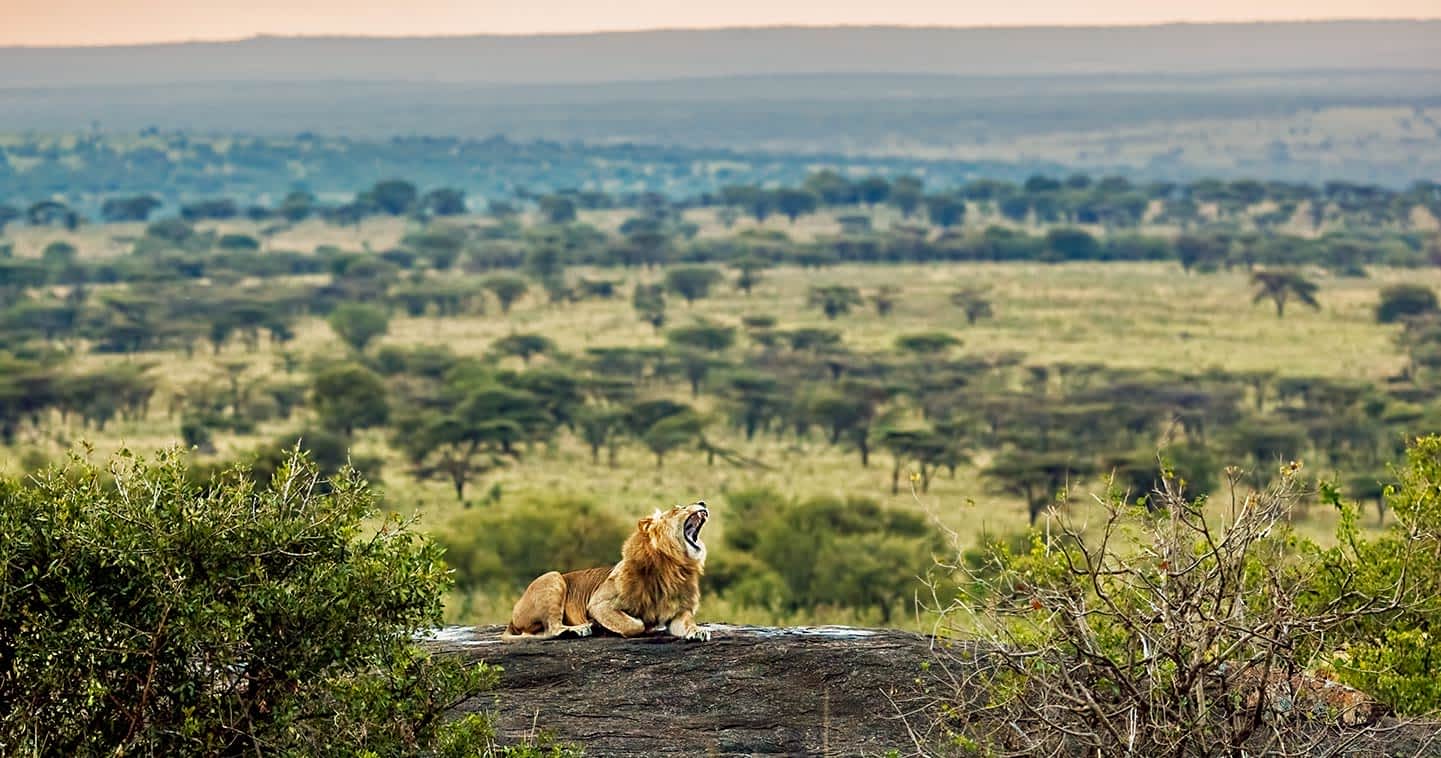
There are places in the world that feel less like destinations and more like another planet. Serengeti National Park in northern Tanzania is one of them.
Stretching across roughly 1.5 million hectares of savannah, the Serengeti is famous for its seemingly endless plains, extraordinary concentration of wildlife, and the spectacular annual movement of wildebeest, zebras and gazelles known as the Great Migration. UNESCO recognizes the park as a World Heritage Site.
The name Serengeti is often associated with wide-open grasslands—and for good reason. Golden plains stretch toward distant hills, interrupted by acacia trees, rocky kopjes, rivers and pockets of woodland.


The landscape changes dramatically with the seasons. Rain can transform the plains into brilliant green grassland, while the dry season brings golden colors and concentrates animals around remaining water sources.
This combination of scenery and wildlife makes the Serengeti one of Africa’s most iconic safari landscapes.
The Serengeti’s most famous spectacle is the Great Migration, a continuous movement of enormous herds in search of fresh grass and water.
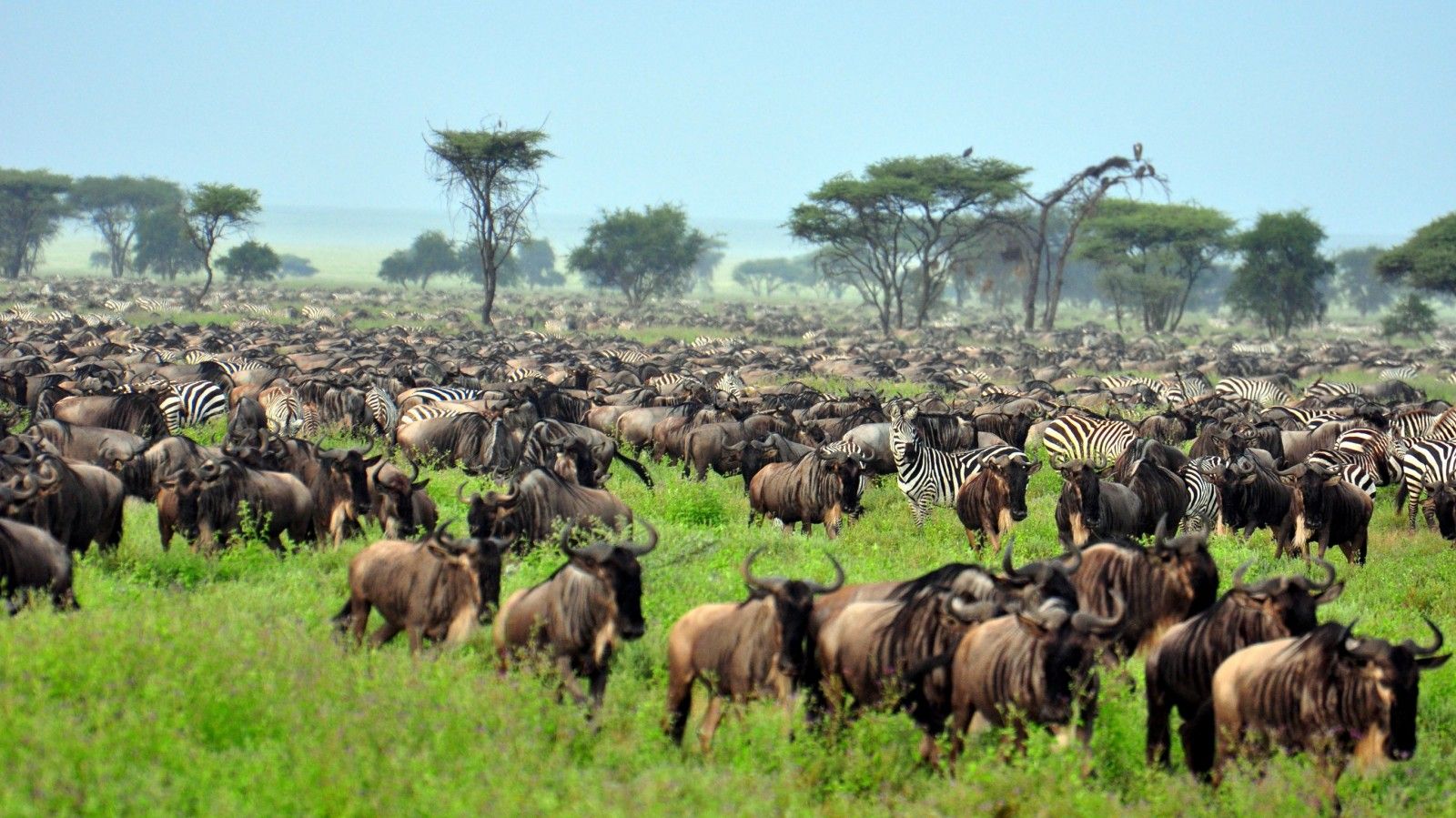

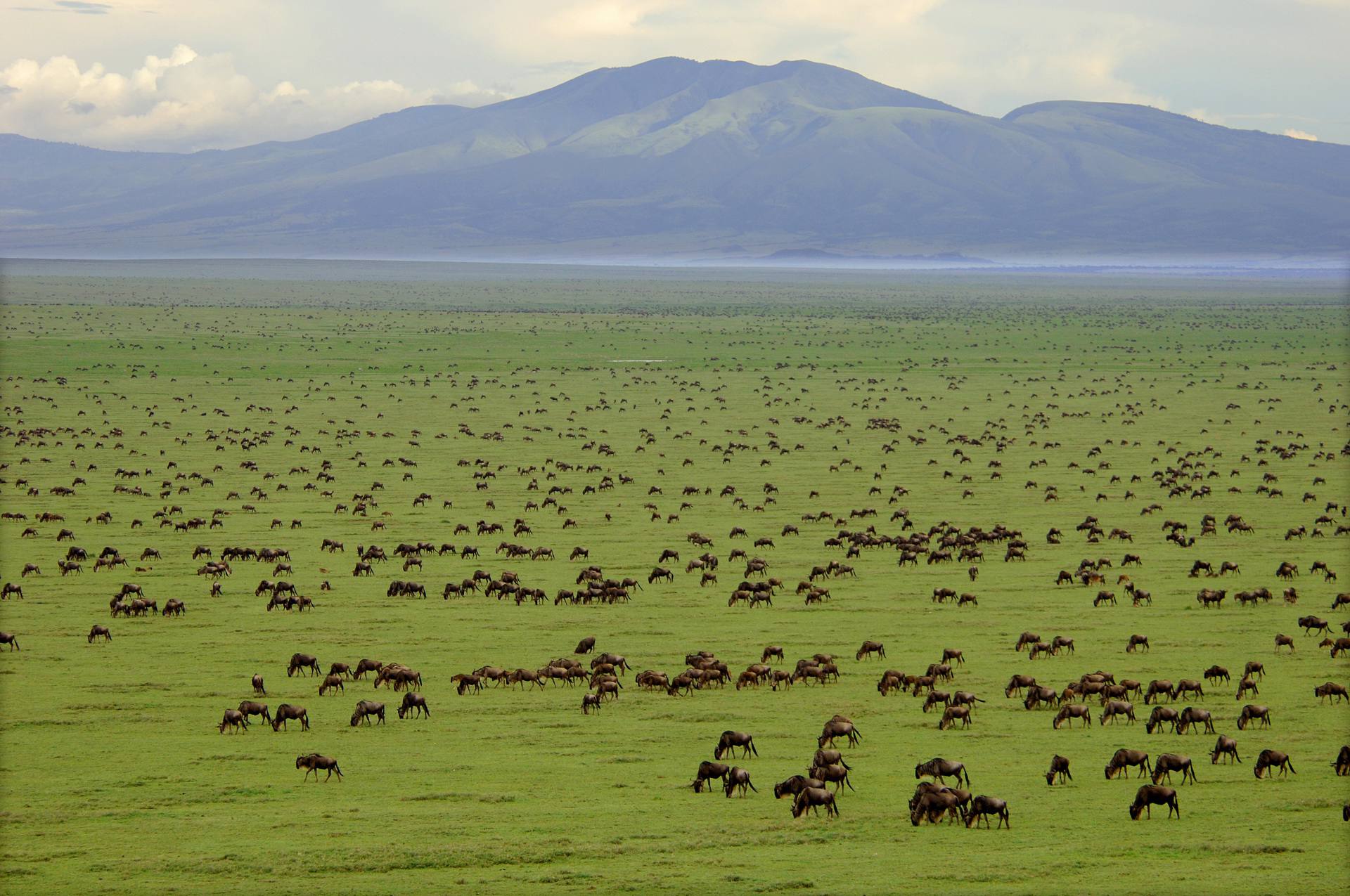

More than a million wildebeest, accompanied by hundreds of thousands of zebras and gazelles, participate in the broader migration across the Serengeti-Mara ecosystem. The journey covers roughly 1,000 kilometers in a vast annual cycle between Tanzania and Kenya.
Where there are enormous herds of herbivores, predators are never far away.
Lions, leopards, cheetahs and spotted hyenas inhabit the Serengeti, creating some of the world’s most dramatic predator-prey encounters. The park is also home to elephants, giraffes, buffalo, hippos, warthogs and many species of antelope.
For visitors on a game drive, the thrill is often not knowing what will appear next. A quiet stretch of grassland can suddenly reveal a pride of lions resting beneath a tree, a cheetah scanning the horizon, or a herd of elephants crossing the road.
Although the Serengeti is famous for the “Big Five”—lion, leopard, elephant, buffalo and rhinoceros—the park’s biodiversity goes far beyond those iconic animals.
The park supports more than 500 bird species, alongside an impressive variety of mammals, reptiles and smaller creatures. UNESCO notes that the ecosystem contains globally threatened species including black rhinoceros, elephant, wild dog and cheetah.
That makes even an ordinary safari drive an opportunity for discovery. Look closely and the Serengeti becomes a world of colorful birds, tiny insects, unusual plants and tracks in the dust.

Wildlife may be the main attraction, but the landscape itself can be just as memorable.
At sunrise, the savannah can glow with soft gold and orange light. At sunset, acacia trees become silhouettes against enormous skies. These quiet moments offer a different side of the Serengeti—one defined not by the excitement of a wildlife encounter, but by space, light and silence.
The Serengeti is more than a spectacular safari destination. It is a critical ecosystem whose wildlife depends on the ability to move across large areas in search of food and water.
Its conservation is therefore closely connected to the surrounding protected areas and the larger Serengeti-Mara ecosystem. UNESCO describes the migration as one of the world’s most impressive natural spectacles and highlights the ecosystem’s exceptional biodiversity.
Perhaps the greatest appeal of Serengeti National Park is its sense of freedom. There are no city skylines, traffic lights or crowded streets—only enormous skies, grasslands, wildlife and the sounds of nature.
Whether you dream of watching wildebeest thunder across the plains, photographing a lion at sunrise, seeing elephants beneath an acacia tree, or simply sitting quietly as the sun disappears over the savannah, the Serengeti offers something unforgettable.
The Serengeti isn’t simply a place to see Africa. It is a place to experience Africa at its wildest.
Article and Picture source: UNESCO World Heritage Centre
Get directions